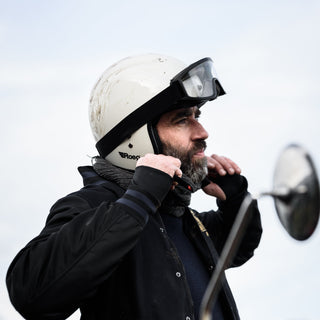
We select helmets that combine proper protection with timeless design. No race-replica graphics, no unnecessary gimmicks. Just helmets we’d actually want to ride in.
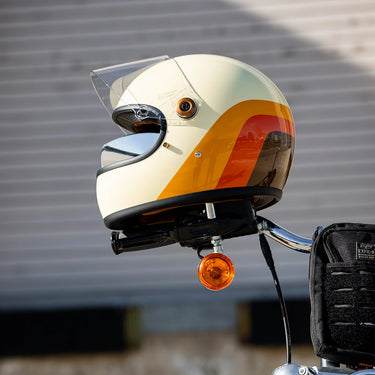
A full-face helmet gives you the most complete coverage and is usually the better choice for longer rides, higher speeds and year-round use. It protects the chin and face, offers more wind protection and is often quieter.
An open-face helmet gives you more airflow, visibility and that classic open riding feel. It works especially well for shorter rides, urban use and riders who prefer a lighter, less enclosed helmet.
Our take: if you ride regularly at speed or in mixed weather, full-face is the more versatile choice. If simplicity and feel matter most, an open-face helmet can be hard to beat.
How tight should a new helmet fit?
A new helmet should feel snug all around your head, without painful pressure points.
When you move the helmet from side to side, your skin should move with it. The helmet should not rotate freely around your head.
A little pressure is normal when the helmet is new. Most comfort liners soften slightly with use, so a helmet that feels loose from day one is usually too large.
Good rule of thumb:
snug = good
painful = too small
moving independently from your head = too large
How do I measure my head?
Use a soft measuring tape and measure around the widest part of your head.
Place the tape:
roughly 1–2 cm above your eyebrows
above the ears
around the widest point at the back of your head
Keep the tape level and snug, but do not pull it tight.
Measure more than once and use the largest consistent measurement.
Then compare that measurement with the sizing chart of the specific helmet brand. Do not assume that a size M fits the same across every manufacturer.
What is ECE 22.06?
ECE 22.06 is the current European motorcycle helmet approval standard.
Compared with the older ECE 22.05 standard, testing is more extensive and includes a wider range of impact scenarios, speeds and test points.
For riders in Europe, we recommend choosing helmets with ECE 22.06 approval whenever possible.
The approval label is not just a technical detail. It confirms that the helmet has passed the required European safety tests for road use.
Is ECE 22.05 still safe?
ECE 22.05 was the previous European standard and many helmets certified under it are still in use.
That does not automatically make them unsafe, but ECE 22.06 introduces more demanding and broader testing.
If you are buying a new helmet today, we would generally choose 22.06 over 22.05.
How often should i replace my helmet?
There is no single number that applies perfectly to every helmet, but a common rule is around five years of regular use.
Replace sooner if:
the helmet has been involved in an impact
the shell is damaged
the EPS liner is compromised
the interior is badly worn or compressed
the helmet no longer fits securely
Even if a helmet looks fine from the outside, impact-absorbing materials and interior components can degrade over time.
Always follow the manufacturer’s replacement guidance.
Do I need to replace a helmet after dropping it?
Not necessarily.
A small drop from seat height onto the ground does not automatically mean the helmet is unusable, especially if nothing heavy was inside it.
But if the helmet:
took a serious impact
fell from significant height
shows shell damage
has cracks or deformation
then it should be inspected or replaced.
When in doubt, contact us or the manufacturer.
Can I wear goggles with any helmet?
Usually, yes.
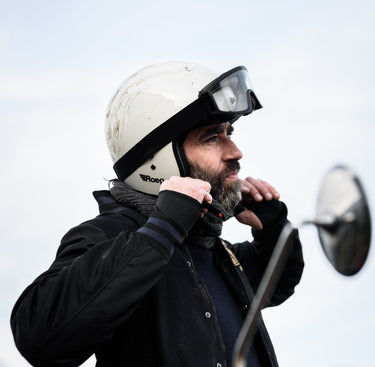
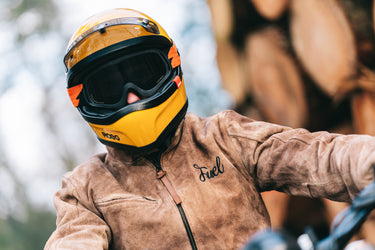
Many open-face and MX-style helmets are designed to work with goggles.
What matters is the eye-port size and shape. Some goggles fit beautifully with certain helmets and poorly with others.
We recommend checking:
goggle width
strap position
helmet shell shape
whether the goggles seal properly around your face
For selected helmets, we can also indicate compatible goggles or visors on the product page.
Feel free to ask us if you're unsure!
What is the difference between fiberglass, composite and polycarbonate helmets?
The main difference is how the shell is made.
Polycarbonate or ABS Usually more affordable and slightly heavier. It is impact-resistant and commonly used in entry and mid-range helmets.
Fiberglass Typically lighter and more rigid, with good impact performance.
Composite Uses a combination of materials such as fiberglass, carbon and aramid fibers. These shells aim to balance low weight, strength and impact management.
The shell material matters, but it is only one part of helmet performance. Fit, EPS construction, certification and overall design are just as important.
Is a lighter helmet always better?
Not automatically.
A lighter helmet can reduce fatigue, especially on longer rides, but weight alone does not determine comfort.
Balance matters just as much.
A slightly heavier helmet that is well-balanced can feel more comfortable than a lighter helmet that pulls forward or creates pressure points.
How do I know if the helmet shape fits my head?
Head circumference is only part of helmet fit.
Different helmets also suit different head shapes:
round
intermediate oval
long oval
Two helmets with the same size label can feel completely different.
That is why we recommend treating the size chart as a starting point, not the final answer.
If a helmet creates one sharp pressure point while feeling loose elsewhere, the shape may simply not suit your head.





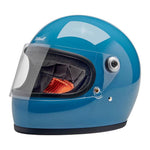

 Roeg JETT helmet - gloss black €179,00 /
 Roeg JETT helmet - Disco ball silver €199,00 /
 Roeg JETT helmet - Sunset gloss €179,00 /
 By City Roadster III Helmet - White/Red


 Roeg Jett Helmet - Curbstone Gold €190,00 /
 By City Roadster III Helmet - Dark Green €235,00 /
 13 1/2 Skull Bucket Helmet - Gloss Black €199,00 /
 Roeg JETT helmet - fog white €179,00 /
 By City Roadster III Helmet - Matt Black €235,00 /


 13 1/2 Skull Bucket Helmet - Matt Black €199,00 /

 Roeg JETT helmet - matte black €179,00 /
 Biltwell Gringo 06 Helmet - Gloss Black €249,00 /
 Biltwell Gringo SV 06 Helmet - Matt Black
 Biltwell Gringo S Helmet - Garnet Red Flames

 Roeg Jett Helmet - Purple Haze €199,00 /
 By City Roadster III Helmet - Gold/Black €235,00 /
 By City Roadster III Helmet - Blue €235,00 /


 Roeg JETT helmet - Army €179,00 /
 Roeg JETT helmet - Thunder clouds €179,00 /

 Biltwell Gringo S 06 Helmet - Matt Black €275,00 /